DIY Altec 2 Way Build ala JELabs - 802/32/414

Do It Yourself
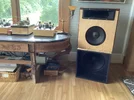
Hi all, I have had my je labs altec build running for about a year, 802d/32c/414/
running woofers fullrange and 1.25 -1.5uf on horn . wondering about stands , and where my ear height at listening position should be relative to the speaker. I come from audiophile background where heavy sand loaded stands and spikes were the norm,but from what I see of other peoples builds this isn't necessary. any thoughts?
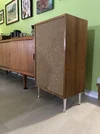
I'm using some spun aluminum furniture legs on my cabinets that add about 5.25" in height:

1776193582094.webp
 
Hi all, I have had my je labs altec build running for about a year, 802d/32c/414/
running woofers fullrange and 1.25 -1.5uf on horn . wondering about stands , and where my ear height at listening position should be relative to the speaker. I come from audiophile background where heavy sand loaded stands and spikes were the norm,but from what I see of other peoples builds this isn't necessary. any thoughts?
Looking good.👍

In that configuration I'd aim for the horn to be at ear level or higher.

Anything that keeps the speakers stable and at proper listening height should be fine, ex: cinder blocks. Or go deluxe like @Thermionics above.😊
 
Looking good.👍

In that configuration I'd aim for the horn to be at ear level or higher.

Anything that keeps the speakers stable and at proper listening height should be fine, ex: cinder blocks. Or go deluxe like @Thermionics above.😊
Agree with this recommendation; get the center of the horn at ear level when you are in your favorite listening spot.
A good way to back into that is to measure from the floor to your ear when you are sitting, let’s just say 33”. Now measure the distance from the bottom of your cabinet to the center of your horn, we will use 28”. This means that a 5” leg like @Thermionics recommended, would get that horn lined up to your ear level.
tenor.gif
 
Looking good.👍

In that configuration I'd aim for the horn to be at ear level or higher.

Anything that keeps the speakers stable and at proper listening height should be fine, ex: cinder blocks. Or go deluxe like @Thermionics above.😊
JE, I want to personally thank you for sharing so many good projects over the years and for fielding the many question that come up for us diyers.
 
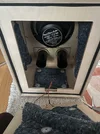
Bobland sent me some revised vents for my 416 cabinets, so I finally glued in the bracing and put in some denim insulation!

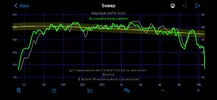
Initial measurements suggest the vent geometry helps bass extension, maybe +6db at 50hz which isn’t nothing. Don’t look at all the choppy stuff above 200hz…
1776559734788.webp
IMG_4102.webp
 
Last edited:
Hi all, I have had my je labs altec build running for about a year, 802d/32c/414/
running woofers fullrange and 1.25 -1.5uf on horn . wondering about stands , and where my ear height at listening position should be relative to the speaker. I come from audiophile background where heavy sand loaded stands and spikes were the norm,but from what I see of other peoples builds this isn't necessary. any thoughts?
Mine are on Isoacoustics Gaia feet, but I do think they could stand to be raised up a bit so the horns are closer to ear level.
 
12” just as in any 12” woofer. My collection is solely 15s right now. Altec, JBL, EV.

Tested some RCF350s on the 32s and they sound very good, but definitely want to cross above 1k.
There are a couple of Magnavox P-232 12" alnico speakers on eBay right now (one is mistakenly listed as a 15" but it's a 12")

Magnavox 12 Alnico C513 P232 Speaker Tube Amplifier | eBay (shipping is quite outrageous, but perhaps you could negotiate)

You could have a pair of extended-range woofers for less than $200 (assuming successful negotiations) that should play quite well with a 32B horn and an 80x compression driver.
 
Bobland sent me some revised vents for my 416 cabinets, so I finally glued in the bracing and put in some denim insulation!

Initial measurements suggest the vent geometry helps bass extension, maybe +6db at 50hz which isn’t nothing. Don’t look at all the choppy stuff above 200hz…
View attachment 118368
View attachment 118397
Very interesting result. Just to make sure I am reading the graph correctly: is the grey trace the original open-slot configuration and the green trace the cabinet with Bobland’s revised vent inserts?

Did Bobland also specify the intended tuning frequency or provide the dimensions of the inserts?
 
Very interesting result. Just to make sure I am reading the graph correctly: is the grey trace the original open-slot configuration and the green trace the cabinet with Bobland’s revised vent inserts?

Did Bobland also specify the intended tuning frequency or provide the dimensions of the inserts?
Yep, grey is big vent, green is tubular tuned vent.

Bob just made up the blocking plate with the 3” holes in it, with nice little circular collars to hold the tubes in place and to make them quick-swappable as needed. He had the dimensions of the stock vent on hand since he built the enclosures.
 
Yep, grey is big vent, green is tubular tuned vent.

Bob just made up the blocking plate with the 3” holes in it, with nice little circular collars to hold the tubes in place and to make them quick-swappable as needed. He had the dimensions of the stock vent on hand since he built the enclosures.
Thanks—that clears up the comparison. The improvement certainly looks worthwhile.
 
Agreed, and I didn’t detect any downsides - the midrange seemed unchanged.
This is particularly interesting to me, as I am about to build enclosures very similar to yours and to those previously made by Heretic.

The original slot vent is enormous, and this result makes me wonder how well its tuning suits different woofers. Since the basic design predates the widespread use of T/S parameters, Bobland’s revised tubular vents seem like a very sensible way of tailoring the enclosure more closely to the particular driver.

After reading your posts and seeing the graph, I am now leaning towards conventional reflex ports calculated specifically for my Altec 414A woofers.
Online calculators suggest that for the volume of the 614, the stock vent tunes the enclosure to ~60hz I think.

Not sure if the 414 would like tuning lower than 40hz in the ~3.5cf of the 614 but it’s so easy to cut multiple tube lengths we should find out…
 
Online calculators suggest that for the volume of the 614, the stock vent tunes the enclosure to ~60hz I think.

Not sure if the 414 would like tuning lower than 40hz in the ~3.5cf of the 614 but it’s so easy to cut multiple tube lengths we should find out…
That makes sense. I had previously estimated the tuning lower, but I now realise that estimate was based on a smaller vent geometry. With the very large, shallow slot in these AD614-style cabinets, approximately 60 Hz seems quite plausible.

The replaceable 3-inch tubes therefore look like an especially useful modification. I would be very interested to know the number and length of the tubes used for the green measurement.
 
Back
Top Bottom