DIY Altec 2 Way Build ala JELabs - 802/32/414

Do It Yourself
That makes sense. I had previously estimated the tuning lower, but I now realise that estimate was based on a smaller vent geometry. With the very large, shallow slot in these AD614-style cabinets, approximately 60 Hz seems quite plausible.

The replaceable 3-inch tubes therefore look like an especially useful modification. I would be very interested to know the number and length of the tubes used for the green measurement.
In the Altec 9849's, which also use a 614 sized cabinet (same exact dims) they used a pair of 3" port tubes 6" long. There is discussion HERE about the differences between the slot port of the 614 and the tubes of the 9849.

- Woody
 
What is the internal volume of this cabinet"

Also, what are the diameter & length of the ports?
The original 614 dimensions:

1785254728312.webp

Internal volume is around 3.5cf, not exactly sure what precise volume is once driver displacement and the bolt-in "sub baffle" are accounted for.

Ports are two 3" diameter PVC tubes, 6" in length.

@Jeb
 
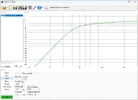
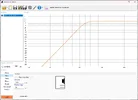
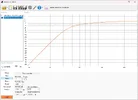
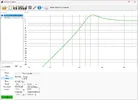
If the online T/S specs I found for the 414A are correct, the woofer will have a response as below in a 3 cubic foot enclosure tuned to 39Hz.

Based on the external dimensions: 24 3/4" x 18 3/4" x 14 1/4" = 3.375 cu ft internal.

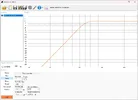
Tuning to a higher frequency will give you a better damping & response and lower F3.

39Hz Tuning
Altec 614 Cabinet with 414A Woofer.webp

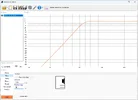
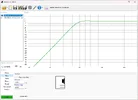
53Hz Tuning
Altec 614 Cabinet with 414A Woofer_53Hz.webp

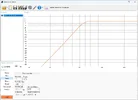
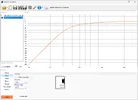
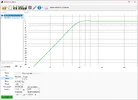
59Hz: Two 3" ports, 2.31" long
Altec 614 Cabinet with 414A Woofer_53Hz_Ports.webp
 
Thank you both — this is exactly the kind of information I was hoping for, and your WinISD simulation seems to confirm that two 3-inch ports approximately 6 inches long would tune a cabinet of around 3 cubic feet close to 39 Hz.

I may be interpreting the cabinet dimensions incorrectly, but multiplying the stated external dimensions gives me approximately 3.83 cubic feet externally. Assuming ¾-inch panels, the internal geometric volume seems to be close to 3 cubic feet before subtracting the woofer, additional sub-baffle, ports and any bracing. I suppose the final usable volume could therefore end up somewhat below 3 cubic feet.

As a rough working estimate, I averaged measurement data from four different 414A woofers, which gave approximately Fs 26.6 Hz, Qts 0.226 and Vas 150 litres. I realise that this is not the same as measuring my own pair, so I would also be interested to know which online T/S figures you used for the simulation.

The comparison with 53 Hz tuning is particularly interesting. As far as I understand the graphs, the higher tuning gives a flatter response and a lower formal F3 by adding more output through roughly the 50–70 Hz region, rather than by extending the response farther below 40 Hz. Please correct me if I am reading that incorrectly — I am still learning how to interpret these alignments.

In any case, the 39 Hz result makes Bobland’s two 3-inch by approximately 6-inch ports look like a very sensible starting point for the 414A. The quick-swappable arrangement is especially attractive, since it would make it possible to try slightly different port lengths and then confirm the result with an impedance sweep and listening.
 
Internal volume is @ 3.375cu ft based on taking 3/4" off each external dimension. 24 x 18 x 13.5 = 5832"/1728" = 3.375 cu ft

1728 = 1cu ft in inches. Minus drivers, braces, etc; net internal volume is close to 3cu ft for simulation.


Altec 414A T-S Specs.webp


You are interpreting the simulation graphs correctly. The higher tuning should yield a better sounding response. With a bass reflex alignment, you typically want a flat passband with a sharp roll-off near cut-off not a drooping response unless it is intentionally for a specific design goal like adding EQ/PEQ to extend an alignment which would be considered a 6th order alignment versus a standard bass reflex alignment which is 4th order.
 
Slightly off topic, but a tool to help re-design or fine tune a lot of these older cabinets predating T/S parameters, DATS (from Parts Express) is indispensable. For $150USD you can test just about any woofer and confirm the T/S specs. Plus it helps with crossovers too.
 
If the online T/S specs I found for the 414A are correct, the woofer will have a response as below in a 3 cubic foot enclosure tuned to 39Hz.

Based on the external dimensions: 24 3/4" x 18 3/4" x 14 1/4" = 3.375 cu ft internal.

Tuning to a higher frequency will give you a better damping & response and lower F3.

39Hz Tuning
View attachment 123902

53Hz Tuning
View attachment 123909

59Hz: Two 3" ports, 2.31" long
View attachment 123910
Awesome, will be great to try a couple shorter tubes on my 614 at some point. The 612 + 416-8B combo is currently in service, will need to run some simulations on that as well...
 
  • Like
Reactions: Jeb
@THD+N

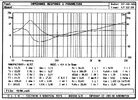
I can now see that the simulation is based on the measured CLIO data shown above: Fs 32.08 Hz, Qts 0.24 and Vas 268 litres. Those figures are quite different from the rough working values I had been using, particularly Fs and Vas, and that seems to explain why the higher tuning produces a much flatter alignment.

Your explanation of the response curves also makes sense to me. The 53 Hz tuning clearly gives the flatter fourth-order alignment and the lower formal F3, whereas the 39 Hz tuning retains somewhat more output below approximately 45 Hz but introduces a gradual downward slope through the upper-bass region.

This makes Bobland’s quick-swappable ports seem particularly useful. It should be possible to begin with the 6-inch tubes, compare them with slightly shorter alternatives, and then confirm the actual tuning with an impedance sweep and listening in the room.
 
Last edited:
@THD+N

I can now see that the simulation is based on the measured CLIO data shown above: Fs 32.08 Hz, Qts 0.24 and Vas 268 litres. Those figures are quite different from the rough working values I had been using, particularly Fs and Vas, and that seems to explain why the higher tuning produces a much flatter alignment.

My provisional figures came from averaging measurements of four different 414A woofers, which gave approximately Fs 26.6 Hz, Qts 0.226 and Vas 150 litres. I realise that averaging four vintage drivers is not the same as measuring my own pair, and it also appears that individual 414As may vary quite considerably. I will therefore regard any simulation as provisional until I can measure my own drivers.

Your explanation of the response curves also makes sense to me. The 53 Hz tuning clearly gives the flatter fourth-order alignment and the lower formal F3, whereas the 39 Hz tuning retains somewhat more output below approximately 45 Hz but introduces a gradual downward slope through the upper-bass region.

This makes Bobland’s quick-swappable ports seem particularly useful. It should be possible to begin with the 6-inch tubes, compare them with slightly shorter alternatives, and then confirm the actual tuning with an impedance sweep and listening in the room.
Don’t forget I’m using GPA 414-8B in my cabs which I think have fairly different T/S than Altec 414s.
 
  • Like
Reactions: Jeb
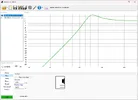
This is true, but I have found with losses and stuffing, you can add back in a few cubic inches. I'll re-simulate for a smaller cab and post.
 
2.6cu ft

54Hz Tuning
View attachment 123928

Ports: 3" ports, 2.81" long
View attachment 123929
Off topic: Might you consider running sims for a 612 enclosure + 416-8B combination?

612 SPEC
Volume: 6 cubic feet
Stock vent: 13" x 5.5" slot
Proposed vent: two 4" x 9.5" tubes

416-8B SPEC
Model No:Xmax (inch)Re (ohms)Vd - (cu. In.)Fs (Hz)Vas - (cu. ft.)Ref (%)QtsQmsQesVid
416-8B0.156.919.225.126.472.70.327.050.330.2
 
612 Enclosure w/ 416-8B: 6 cu ft, tuned to 30.75Hz
Altec 612 Cabinet with 416-8B_6cu ft_30.75Hz Tuning.webp

Ports: Two 4" ports, 9" long
Altec 612 Cabinet with 416-8B_6cu ft_30.75Hz Tuning_Ports.webp

612 Enclosure w/ 416-8B: 6 cu ft, tuned to 42Hz
Altec 612 Cabinet with 416-8B_6cu ft_42Hz Tuning.webp

Ports: Two 4" ports, 3.44" long
Altec 612 Cabinet with 416-8B_6cu ft_42Hz Tuning_Ports.webp
 
That comparison makes the point very clearly. With this particular driver and cabinet volume, the original short slot appears to tune much too high, while 30.75 Hz produces a noticeably falling response. The 42 Hz alignment looks like a very convincing middle ground. It is interesting how the most useful tuning is not necessarily either the historically original one or the lowest possible one.
 
Although a flat passband response is the desired goal, a lot of times, a few dB of ripple (2~3dB) is not a bad thing depending on the application and particular woofer. A few dB of ripple can emulate a "bass boost" if needed for a particular need or again an application.
 
Back
Top Bottom