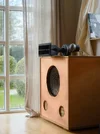
DIY Aperiodic loudspeakers

Do It Yourself
Work completed so far on my high-efficiency loudspeaker project.

The system is built around vintage alnico drivers from the 1970s–80s:
  • Coral 15L-2 woofers
  • Onkyo HM-450A midrange horns
  • Fostex T825 horn tweeters
The crossover philosophy is deliberately minimalist:
  • first-order network throughout
  • single coil on the LF section, combined with a Zobel network
  • single capacitor plus series attenuation on the MF
  • single capacitor only on the HF, with no attenuation
Overall system efficiency is around 100 dB, including some natural room gain in the lowest octaves.

The result is an extremely revealing system, yet still relaxed, organic and deeply “music first” in presentation.

Instagram project post1000024813.webp
 
Last edited:
Awesome job!

Tell us more about the aperiodic vent design! How did you "tune" this untuned cabinet?
 
Awesome job!

Tell us more about the aperiodic vent design! How did you "tune" this untuned cabinet?
Thanks. The cabinets originally came from a gentleman who used Altec 416’s in them, hence the classic large-volume design with dual ports.

When I resumed my audio enthusiasm last year, I wanted to create something around the vintage Coral 15L-2 woofers, which have a fairly high Qts around 0.4. I was never particularly fond of conventional reflex tuning, so experimenting with the aperiodic principle became the natural direction.

My previous system back in the 2000’s was Altec Duplex 605B’s in open baffles with custom crossovers, so I have long been drawn toward more “breathing” and less mechanically damped bass alignments.

The tuning itself was done entirely by listening. I started with very tightly packed rolls of damping material inside the ports, then gradually reduced and loosened the density until reaching a point where the cabinet allowed as much deep bass output as possible, while still maintaining control and natural transient behaviour.

At the same time, the internal cabinet damping was gradually reduced to a minimum. Too much damping killed dynamics and low-level life, while too little made the upper bass/lower midrange too lively. The final balance ended up surprisingly delicate.

Over the years I have read a number of articles about aperiodic loading and always wanted to explore the principle in practice. The overall philosophy behind this project is simplicity and coherence.

The solid-core OFC speaker cables run uninterrupted directly from the amplifier terminals to the woofer terminals through the rear panel. The crossover is simple first-order throughout:

• 1 mH coil + Zobel on LF
• capacitor + series resistor on MF
• capacitor only on HF

The result is bass that feels tight, dry, fast and surprisingly deep for such a vintage lightweight paper-cone driver, while still preserving the openness and immediacy I was looking for.

One of the strongest impressions so far is how physically present a grand piano becomes through the system. There is a convincing sense of wood, strings, hammer attack and harmonic decay, where the instrument suddenly feels less reproduced and more present in the room. I believe part of this comes from the unusually good condition of the Coral woofers themselves - the paper surrounds are still highly compliant, and the lightweight cones and strong motors allow transients and low-level dynamics to breathe very naturally.

At some point I will probably perform proper in-room measurements as well, mainly out of curiosity regarding the interaction between the aperiodic loading, the high-efficiency drivers and the simple first-order crossover. But so far, the entire tuning process has been guided by listening.
 
Awesome execution, what's the driver on the Onkyo horn?
Thanks!

The Onkyo HM-450A horn uses its own dedicated compression driver. It was originally designed for Onkyo’s Scepter series loudspeakers, and as far as I understand, the driver/horn combination was developed specifically as a matched unit.

Like the Coral 15L-2 woofers, there is surprisingly little technical information available today. This is probably the most interesting reference I have been able to find so far:


Sonically they are fascinating units. Very high resolution and dynamics, yet never fatiguing or aggressive. The presentation is extremely natural and open, with excellent transient behaviour and a very coherent tonal character. With eyes closed, I don’t really think “horn”, but more the organic character of a very good paper cone driver - just with far greater dynamics and ease.

In a way, they seem to combine some of the qualities I love most about both worlds. For my personal taste and listening priorities, I somehow find them even more convincing than the Altec Duplexes I used years ago, which at that point were the best loudspeakers I had personally experienced and the ones that replaced my former Audio Note AN-E’s.

In my setup they are crossed to the woofer using only a single capacitor and series resistor, first-order. The horn itself seems to roll off very naturally towards the highest octave, while the Fostex T825 tweeter takes over gradually from around the 6–7 kHz region.
 
I adopted the same philosophy.
Simple, effective with old quality components.
Congratulations.👏
Thanks Edmontus. I’m very curious about your speakers as well?

I somehow feel many of us eventually arrive at a similar philosophy after years of experimenting - simplicity, coherence and a few really good components often seem more musically convincing than endlessly complex solutions.
 
That is so true!

I like to use full range drivers that don't need any low pass then lay in a tweeter with a cap (and resistor/autoformer if necessary for matching.)

We were discussing aperiodic loading in another thread. I think one of the reasons it is not tried more, aside from being a relatively obscure corner of the cabinet world, is that it resists algorithmic solutions. It is a cut and try endeavor. No design software exists.

I don't know...it seems like many people don't like this idea or are intimidated by it. And your approach runs contrary to a lot of contemporary scientific speaker builder dogma but I'm sure you don't care about that! 😁

Enjoy!
 
I somehow feel many of us eventually arrive at a similar philosophy after years of experimenting - simplicity, coherence and a few really good components often seem more musically convincing than endlessly complex solutions.
This is definitely the way I am leaning these days. I think I could be happy for a long time with a few watts SET and single driver in a really nice cabinet.
 
Cool speakers 🙂
I do go along with J Rob and think aperiodic is voodoo so to speak in today's world.
I have been planning something similar with some Jensen drivers and studying older designs that incorporate the principle.
Nice work !
 
At the same time, the internal cabinet damping was gradually reduced to a minimum. Too much damping killed dynamics and low-level life, while too little made the upper bass/lower midrange too lively. The final balance ended up surprisingly delicate.

Lovely speakers and design/desire philosophy.

The above quote peaked my interest, so do you think tuning the internal damping of the cabinet was like a volume control, of sorts, on the cabinets natural resonating frequency, that sounds to be in the bass/lower mid frequency ?

I have head an effect that may be similar, on a DML panel (3mm plywood) of all things, and instruments like piano, guitar, violin etc, sounded wonderful, but vocals also had a wood like vibration to them which was not ideal. Thinking back, adding a crossover to keep them under their ability to influence the delicate region of vocals may have worked.

Modern thinking seems to be to make the cabinets as dead as possible, but I can see that when done with wisdom it can enhance the life like qualities of the music. It seems like a dance to keep each component in the system within a range that they shine.

edit: I can't help but think an old rounded edge picture frame cut down to fit around the mid horns mouth might reduce reflections and could even be be visual appealing too.... ;-)
.
 
That is so true!

I like to use full range drivers that don't need any low pass then lay in a tweeter with a cap (and resistor/autoformer if necessary for matching.)

We were discussing aperiodic loading in another thread. I think one of the reasons it is not tried more, aside from being a relatively obscure corner of the cabinet world, is that it resists algorithmic solutions. It is a cut and try endeavor. No design software exists.

I don't know...it seems like many people don't like this idea or are intimidated by it. And your approach runs contrary to a lot of contemporary scientific speaker builder dogma but I'm sure you don't care about that! 😁

Enjoy!

Lovely speakers and design/desire philosophy.

The above quote peaked my interest, so do you think tuning the internal damping of the cabinet was like a volume control, of sorts, on the cabinets natural resonating frequency, that sounds to be in the bass/lower mid frequency ?

I have head an effect that may be similar, on a DML panel (3mm plywood) of all things, and instruments like piano, guitar, violin etc, sounded wonderful, but vocals also had a wood like vibration to them which was not ideal. Thinking back, adding a crossover to keep them under their ability to influence the delicate region of vocals may have worked.

Modern thinking seems to be to make the cabinets as dead as possible, but I can see that when done with wisdom it can enhance the life like qualities of the music. It seems like a dance to keep each component in the system within a range that they shine.

edit: I can't help but think an old rounded edge picture frame cut down to fit around the mid horns mouth might reduce reflections and could even be be visual appealing too.... ;-)
.
Thanks, very interesting reflections. I actually think you describe the phenomenon quite well.

What I gradually experienced during tuning was that the amount and placement of internal damping did not only affect bass quantity, but also the “character” and energy distribution of the lower registers and lower midrange. With too little damping, the cabinet/woofer interaction became a bit too lively and forward in the upper bass/lower mid area. Piano gained enormous presence and dynamics, but there was also a point where certain tones could begin to sound slightly too “wood resonant”, if that makes sense.

By gradually reintroducing damping asymmetrically and in relatively small amounts, I found a balance where the system kept most of the openness, low-level life and transient speed, while calming the more excessive resonant behaviour. So yes, in a way it almost behaved like a very subtle “gain control” on the cabinet’s contribution to the sound.

I also think modern cabinet philosophy sometimes underestimates how much musical life can disappear when everything is pushed towards maximum rigidity and absorption. Of course uncontrolled resonances are undesirable, but perhaps there is a middle ground where certain carefully controlled resonant behaviours can contribute positively to the natural character of acoustic instruments.

The interesting part is exactly as you describe - it becomes a kind of balancing act where every element has an operating window where it really shines.

And yes, your observation about vocals makes perfect sense to me. I suspect the reason I avoid most of that coloration is partly because the Onkyo horn takes over relatively low, around 1.1–1.2 kHz, meaning the woofer/cabinet interaction is less involved in the critical vocal region.

The rounded frame idea around the horn is actually quite interesting as well. Both acoustically and visually it could potentially soften edge reflections a little. I may experiment with something along those lines at some point.
 
Interestingly, I actually came across this old academic thesis on the aperiodic loudspeaker principle years ago, long before starting this project, and it immediately caught my interest.

To be honest, I am not mathematically trained at all and would never be able to compute any of the theory myself. Loudspeaker construction has simply fascinated me since I was a young teenager, and much of what I have learned over the years has come through listening, experimenting and curiosity.

Still, I find it fascinating that there actually exists a quite substantial scientific and engineering foundation behind the aperiodic principle — especially because some of the behaviour described in the paper corresponds surprisingly well with what I have experienced empirically while tuning the system by ear.

So for those interested in the more technical side of the subject, I thought the document might be worth sharing.
 

Attachments

This paper looks very interesting but too early in the morning to read THAT, so I skipped to the conclusion. Maybe I'll comb though it on the plane en route to the Vienna HighEnd show this week if they don't have any good Kung Fu movies on in-flight entertainment.

Apparently, it resolves to trial and error methods backed by impulse response testing.

Since it is a thesis, the author couldn't simply use his ears, Had to go with transfer function "verified" by a measurement mic.

The problem I've identified with all such academic treatments of the subject is that the equations imply the existence of some sort of aperiodic damping factor as a primary variable...but there is no way to characterize this quality before the fact for a given port damping device.

In other words, it is possible to characterize the role and mechanism of the damping device using standard electrical analogies for the mechanical system but we can only know its' magnitude by trial and error looking at results. This is explanation rather than prediction.

What would be needed to come up with missing AperBox 1.10 design software is a system to characterize and manufacture a line of calibrated damping devices that one could order online and screw into the baffle to meet the prescriptive mathematical requirements of the design algorithm.

And I doubt that is ever going to happen.

Furthermore, I am not sure this will actually correspond to the "right" tuning as determined by ear, in the design process offered by OP, since there are so many other things going on with the cabinet, such a internal damping and panel resonances as discussed.

Then there is the question of taste and preference and the experienced and educated listeners overall appraisal of quality and design success, some things that will never be a drop-down menu item in a software program.

In short, long live audio experimentation!
 
I have looked at that paper and several others along the same line.
They are a good reference and give a path to follow, but leave me with same conclusion.. you will need to finalize your application with listening and adjusting/ experiment.
But, isn't that half the fun here ? 😎
 
Back
Top Bottom