Beyma coaxials…in the house!

You can add block styrofoam or red bricks to occupy space in your big cabinet as a test to reduce volume.

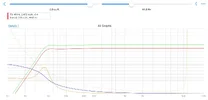
Here is where I am on the box model

IMG_0504.webp

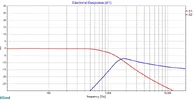
the orange line is the group delay, and it’s peaking a bit, there. When I had the GPA 414 loaded in the modeler, the Beyma was higher on the group delay in the low bass. Decreasing the volume does bring that peak down. My theory was that decreasing the value of the zobel capacitance increases the impedance in the low bass, decreasing the group delay added by the crossover. I think that’s why it helped.

My crossover is on a plywood board, so once it’s done, I’ll put that in the cabinet for some marginal additional improvement, hopefully.

The speakers are sounding very, very good and they do produce deep bass. Definitely more bass than the 414, but maybe not as high quality bass as the 416. The cabinet is a third the size of the 416, though.
 
There is no scale reference for GD on your graph, but in my experience, 50mS or less of GD is acceptable and not audible, especially in the bass region.
 
Ok, bear with me, here. Since, it's a coaxial, I've been taking my measurements right up on the cone, with the mic flush with the baffle, about.

On DIY audio, there's a thread I was reading about pro audio coaxials, why would you want a raggedy pro coaxial? They were saying some of those dips, like the one at 5k, were often inherent in the sound, due to an internal reflection. I also noticed the Celestion coaxial has something very similar, a couple deep, narrow notches. So, I wanted to back off the mic placement to see if that stuff in the prior measurement was a reflection to the mic. I have to confess, I also made a couple tweaks to the hi cut filter to take down a bit more top...it was just a bit too much. But, it's mostly comparable.
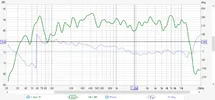
Beyma 3 Feet.webp

So, this is three feet out, 1/6th smoothing with the scale back to how I usually have it. Generally, I consider it a victory if I can contain the waviness to a 5 or 6 db range, I've got some peaks at this setting, but generally pretty good...especially considering how flat that phase is. There's still that something at 5khz, so I guess it's part of the driver...just at the bottom of my 5 or 6 db window. Now it could be deeper and just covered up by the smoothing, so here's another look.
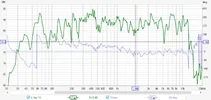
Beyma 3 Feet 48.webp

Now, that is 1/48th smoothing, and we can see that the 5khz, although it has another 5 or 6 db to plunge, it's super narrow, comparable to some of the waviness in the bass due to letting the room into the measurement. It's certainly something I don't hear, but does seem to be part of the driver, rather than a reflection off the mic.
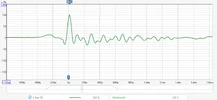
Beyma Impulse.webp

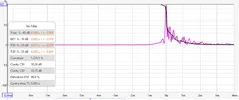
Really happy with the impulse at 3 feet, too.

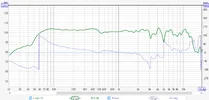
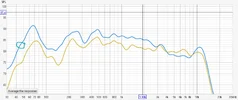
While I was at it, I tried to get something close to the listening position. This one is pretty smoothed to show the general idea...
Beyma Listening Position.webp

Ok, the blue one is both speakers on, and the yellow is just one. Now, I am convinced my Dayton USB test mic is not a true omnidirectional. It has struck me as having some strong cardiod tendencies at the highs, so with both speakers on, mic pointed at the center, it gives a droop in the 4k-8k which I don't think is real. Hence, I added the single speaker with the mic pointed at it, to give the general sloping downward, target curve like response I've ended up with at the listening position.

But, I like the blue curve to try and show where the bass is. I've circled the general 45 hz area of where -3db was modeled to occur. If one looks at 68 db as a peak, and perhaps "flat" is the 84 db line around the 600-1.5k area, then that's about right. I guess I'd have to measure outside to know for sure. Who knows? I tend to always have that dip in the 100-200hz range in this room.

I may REALLY be ready to order my resistors, now....probably not....
 
Audio Science is a wonderful thing ain’t it?
Music at its pinnacle is pure pseudoscience…a musician plays some sounds that evokes a feeling in a listener. Totally personal and unprovable.

Audio science, as a concept…taking a systematic approach to perfecting and quantifying why things sound the way they do is indeed a wonderful thing.

Audio science, as a term on the internet, seems to be just shorthand, for “everything I can’t measure is snake oil.” As such, I think it tends to be like a consolation prize for perceptual failure. As in, “I can’t hear what these cables sound like, but I’m more scientific than the people who can.”

There’s a lot of audio science that would lead one to the conclusion that the whole time alignment/linear phase thing is not audible. Unfortunately, for that body of science, I haven’t found it to be true.

That’s one of the reasons the measurements and tests I do myself are the ones that truly matter to me, because ultimately, it’s pseudoscience and it has to be heard to be believed.
I have found that time alignment/minimum phase contribute to a coherent wave front and makes the sound stage/stereo image open up and sound natural more than a flat frequency response with minimum aberrations and no attention at all to time alignment/phase.
 
I have found that time alignment/minimum phase contribute to a coherent wave front and makes the sound stage/stereo image open up and sound natural more than a flat frequency response with minimum aberrations and no attention at all to time alignment/phase.
I would agree with you, our brains take care the oddities in frequency response unless extreme.
 
I’ve always followed the “measure both speakers at once for your bass response, but one at a time for full range curves” technique. You’ll always have some cancellation up top with a single mic measuring two sources playing the same sound. Comb filtering sees your fractions of an inch lol.

Measure each speaker individually (and then swap the horn/tweeter polarity to check for a crossover null to ensure phase is as expected) to dial in the response, for sure.
 
It’s like Miles said, “Time isn’t the main thing, it’s the only thing.”

I don’t think it’s a coincidence that guys like Floyd toole who maintain the inaudibility of phase also believe evaluation should be done in mono; conclusions made in mono always remain when moving to stereo, so there’s no point in evaluating in stereo.

It may well be the science is steeped in mono listening.

I totally agree that the imaging sound stage is vastly improved…it’s really like everything snaps into sharp focus…but I think every attribute of evaluation improves…the bass, clarity, the top end., dynamics. It’s like a high efficiency speaker generally is fast, and quick in acceleration, and the time alignment brings the speed in deceleration…the speaker shuts up at the right time, too. There’s a level of musical expression that emerges, I guess the audiophiles call it prat, you hear that extra little bit of feel the musician squeezes in. It generally makes for a more intense experience…you just keep listening on and on…

Anyway, I guess I like it…
 
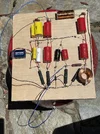
IMG_5697.webp

Like I said, difficult to do the charge coupling and not look a bit crazy. Hopefully, I did that right…hard to follow the mess of extra parts and test leads I had…

Oh, and I will go out on a limb and say I like the sound of the red Audiophiler caps…a bit more vibrant sounding than the usual cheap film, and prefer the light brown mills resistors to the black…
 
Who sells those particular "Audiophiler" caps?

I buy them from seller MTG-90 on eBay.


Inexpensive for the big values. The ones that aren’t the red audiophilers are due to a change of plan.


IMG_5698.webp

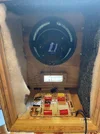
The board barely fits…had to wedge it down in there…

I even soldered on flag terminals…I feel like such an adult…test leads to flag terminals…like moving from a dorm room to a house…
 
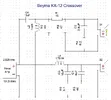
I'm just gonna ask: do you @Phillip Jeffries think that this XO would be a good starting point for the newer 12CXA400Fe? The 12KX went out of production so I'm asking because i ordered the new version with the XO Beymer sells with it and want to put it in an Altec 614 DIY cabinets as well.

​

 
Well, hold on now. If the distance between the acoustic centers of the drivers is the same, that would be the critical specification. Then you would adjust the pad on the horn to convert it to 8 ohm, although, if I remember correctly, the pad I made there is already more like a 16 ohm. That’s something I noticed about the Urei time align, too, I think the pad is more like a 16 ohm than a 8 ohm.

On the other hand, I doubt there’s anything I know that Beyma doesn’t also know. Their stock crossover, since you only need a 2nd order to flatten the phase, is probably going to already be “pre tweaked” so to speak.

Will be interested to hear your thoughts on the new version with the horn!
 
Back
Top Bottom